

If Aliens Exist, Does Christianity Fall Apart?
November 12, 2025Did MIT Just Prove That Thoughts Create Reality? (Spoiler: No… But It Got Interesting.)
November 23, 2025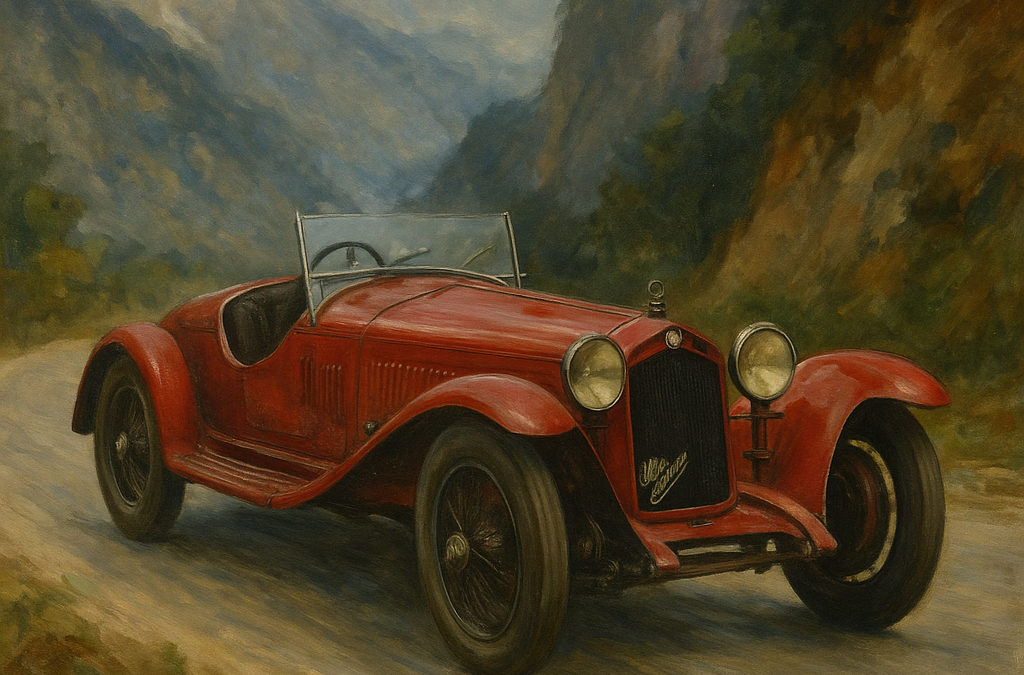
If you lined up every great sports car you and I drool over—from 550 Spyders and E-Types to 911 GT3s and modern Ferraris—you’d discover something slightly awkward:
They all descend from a handful of slightly deranged people in the early 1900s who looked at a perfectly sensible motor car and thought,
“Right. Let’s make this completely impractical and obscenely fast.”
This is the first post in a LinkedIn series on the history of the sports car: where it began, why it matters, and what it tells us about engineering, culture, and the future of driving in a world determined to turn everything into an app.
So what is a sports car, really?
Today, “sports car” gets slapped on anything with a spoiler and an ego problem. Historically, it meant something much more specific:
- Light weight
- Two seats (or 2+2 if you really hated your rear passengers)
- Engine and chassis tuned for driving pleasure, not practicality
- A clear connection to competition or spirited driving
In other words, a car where performance and the “thrill of driving” trump carrying capacity—very much in line with modern definitions that emphasize handling, acceleration, and racing capability over practicality. Wikipedia
A proper sports car was never built to carry the family, the dog, or a month’s worth of Costco. It was built to go quickly, feel alive in your hands, and make you question your life insurance choices.
The earliest sports cars were essentially racing cars you could—technically—drive to the shops. That tension between road car and racing machine is where the story really starts.
The Prince Henry Trials: where the trouble started
Before World War I, Europe had fallen in love with long-distance “reliability trials”—multi-day events over awful roads, filled with dust, mud, and the occasional hedge.
One of the most important was the Prinz-Heinrich-Fahrt (Prince Henry Tour), run from 1908 to 1911 and named after Prince Heinrich of Prussia. It was a contest for production touring cars with four seats and three passengers—no pure racing specials allowed. Wikipedia+1
On paper, it all sounded very proper and respectable. In reality, manufacturers looked at the regulations and thought:
“How fast can we possibly go while still pretending this is a normal car?”
That’s the moment the sports car appears on the evolutionary chart.
Two key machines emerge from this chaos:
- The Vauxhall C-10 “Prince Henry” from Britain
- The Austro-Daimler Prinz Heinrich engineered by a young Ferdinand Porsche
Both were created to win Prince Henry events and then sold to customers who wanted that same performance on the road. “Track day, then Waitrose” is not a new idea.
Vauxhall Prince Henry: Britain’s “first sports car”
Engineer Laurence Pomeroy at Vauxhall took the Prince Henry regulations and, as all good engineers do, bent them right to the snapping point. He designed a lighter chassis, tuned the four-cylinder engine to around 60 bhp, and created a fast, relatively sleek four-seat tourer. Wikipedia+1
Three of these cars ran in the 1910 Prince Henry event; they did well enough that Vauxhall built a road version for customers. Contemporary coverage described it as a “particularly fast, light car for road work,” with Vauxhall confidently claiming it could exceed 90 mph in the right trim—heroic stuff for 1910 roads. Stellantis Media+1
Because it combined:
- A production chassis
- Genuine competition pedigree
- High performance based on clever design rather than sheer size
…the Vauxhall Prince Henry is often described as one of the first true sports cars, sometimes even the first. prudentplus.co.uk+4Wikipedia+4nationalmotormuseum.org.uk+4
Essentially, it was the moment someone said, “Yes, it has four seats, but let’s be honest, this is really about the driver.”
Austro-Daimler and a young Ferdinand Porsche
Meanwhile, over in the Austro-Hungarian Empire, Austro-Daimler wanted in on the Prince Henry glory. They turned to a young engineer named Ferdinand Porsche, who would later become slightly famous for designing things like the Porsche 356 and 911.
His Prinz Heinrich-Wagen was a highly advanced touring car with a powerful four-cylinder engine, built specifically for the event. Wikipedia+3fahrtraum.at+3Porsche Cars History+3
In 1910, Porsche won the Prince Henry Tour overall in an Austro-Daimler, with his teammates taking second and third—a factory clean sweep. Stuttcars+2PurelyPorsche+2
Crucially, Austro-Daimler also offered road-going versions of these cars to private owners, giving wealthy customers a machine with very real competition DNA. It’s the same basic promise you see today in GT3s and special-series Ferraris: you too can drive something related to the race car—assuming your bank account survives the experience.
You can draw a remarkably straight line from those Austro-Daimlers to later Porsche road cars: compact, sporting machines designed to cover long distances quickly on real roads.
“Weren’t there fast cars before this?”
Absolutely. From the very start of motoring there were monstrous racing and record-breaking cars—huge engines, minimal bodywork, and brakes that were more of a suggestion than a system.
But the Prince Henry generation did something new:
- The cars had to be production touring cars
- They had to carry passengers and look vaguely respectable
- They were then sold, in similar form, to private owners
So you no longer have just race cars and touring cars; you now have a hybrid category: a road-legal car, derived from competition, with performance as its defining feature. That’s the sports-car template.
This is also where the term “sports car” starts to appear in print in the 1910s and 1920s to describe performance-oriented roadsters and light tourers. Wikipedia+2Wikipedia+2
From experiments to a repeatable formula
Once manufacturers realized there was a market for fast, agile road cars, the idea spread quickly through the 1920s.
MG: the “everyman” sports car
In the early 1920s, Cecil Kimber, general manager at Morris Garages, began modifying ordinary Morris cars into lighter, sportier versions to boost sales. These evolved into the MG 14/28 Super Sports of 1924—often seen as the first true MG sports car, built on a Morris Oxford chassis but with more sporting bodywork. cmhmg.co.za+5Wikipedia+5mgpalestine.com+5
The recipe was refreshingly simple:
- Modest power
- Low weight
- Open bodywork
- Handling that made country lanes much more interesting than they had any right to be
If you couldn’t afford a Bentley, you bought an MG, a scarf, and a pair of goggles—and annoyed everyone in your village.
Bentley 3 Litre: endurance weapon
At the other end of the spectrum, Bentley created the 3 Litre, its first production model, starting in 1921. Designed by W.O. Bentley, it used an advanced overhead-cam four-cylinder engine and a robust chassis, explicitly engineered for speed and endurance. Wikipedia+1
The 3 Litre famously won the 24 Hours of Le Mans in 1924 and again in 1927, establishing Bentley as a dominant force in long-distance racing and cementing its reputation for building fast, durable road cars. frankdale.com+1
These weren’t delicate toys; they were big, loud, and capable of crushing continents. Think of them as the grand tourers and super-GTs of their day—yet still very much part of the sports-car story.
Alfa Romeo 6C 1750: the elegant assassin
By the late 1920s, Alfa Romeo refined the sports-car formula with the 6C 1750: a relatively light chassis, twin-cam inline-six, and bodies by coachbuilders like Zagato. Wikipedia+1
The 6C 1750 won virtually everything worth winning in 1929 and 1930—Mille Miglia, Spa 24 Hours, and more—proving that a well-balanced, moderately sized car could humiliate much larger machinery on road and track alike. Wikipedia+1
Here, the modern sports-car template is fully recognizable:
- Compact, relatively light chassis
- Advanced engine technology
- Strong racing record
- Styling that makes rational thought evaporate
If the Prince Henry cars were the Big Bang, machines like the MGs, Bentleys, and Alfas are the first well-formed galaxies.
Why this matters in 2025
You might reasonably ask: Why should anyone care about obscure cars from a century ago, other than to look smug in comments?
Three reasons:
- They show how innovation actually happens.
The first sports cars weren’t built by committee or focus group. They emerged from constraints (Prince Henry regulations), competition, and a few stubborn individuals who wanted to go faster than was strictly sensible. Wikipedia+2New Atlas+2 - They remind us that passion drives entire industries.
Nobody needed a Vauxhall Prince Henry or an MG 14/28. People wanted them because they represented skill, courage, and a bit of madness. That same irrational passion still drives adoption of new tech today—whether that’s a cutting-edge EV, an AI tool, or the latest gadget that definitely doesn’t solve any real problem but looks fantastic doing it. Simeone Foundation Automotive Museum+4smiths-instruments.co.uk+4mgpalestine.com+4 - They frame the crossroads we’re at now.
As we move into electric, autonomous, and subscription-everything, the sports car becomes a cultural test case: Are we willing to preserve machines whose primary purpose is joy, not utility? Sports cars are a reminder that not every piece of technology needs to be optimized for efficiency. Some exist simply to make us feel vividly, gloriously alive.
This is just the opening chapter. In later posts, we’ll dig into:
- The post-WWII explosion of affordable sports cars (MG, Triumph, early Porsche)
- The Italian golden age: Ferrari, Maserati, Lamborghini
- The “everyday” sports car—911s, Z-cars, Corvettes, and beyond
- And finally, what “sports car” means in an electric, algorithmic future
For now, it’s enough to know this:
The sports car wasn’t invented in a meeting room. It was born on terrible roads, in long-distance trials, by people who decided that getting from A to B was fine—but getting from A to B quickly, loudly, and with a ridiculous grin on your face was far better.
Works Cited
“Alfa Romeo 6C.” Wikipedia, Wikimedia Foundation, n.d. Accessed 14 Nov. 2025. Wikipedia
“Bentley 3 Litre.” Wikipedia, Wikimedia Foundation, n.d. Accessed 14 Nov. 2025. Wikipedia
“Bentley 3 Litre Model Guide.” Frank Dale Rolls-Royce & Bentley, Frank Dale, n.d. Accessed 14 Nov. 2025. frankdale.com
“Britain’s First Sports Car—The Vauxhall C-10 ‘Prince Henry’.” Sports Car Digest, VR Staff, n.d. Accessed 14 Nov. 2025. Sports Car Digest
Caerbont Automotive Instruments. “Origin of the MG Sports Car.” Caerbont Automotive Instruments, 2025. Accessed 14 Nov. 2025. smiths-instruments.co.uk
“History of MG.” MG Motor, n.d. Accessed 14 Nov. 2025. mgpalestine.com
“MG 14/28.” Wikipedia, Wikimedia Foundation, n.d. Accessed 14 Nov. 2025. Wikipedia
“Prinz-Heinrich-Fahrt.” Wikipedia, Wikimedia Foundation, n.d. Accessed 14 Nov. 2025. Wikipedia+1
“Sports Car.” Wikipedia, Wikimedia Foundation, n.d. Accessed 14 Nov. 2025. Wikipedia
“24 Hours of Le Mans Centenary – 1924–1930: The One of a Kind Bentley Boys.” 24h-lemans.com, Automobile Club de l’Ouest, 28 Nov. 2022. Accessed 14 Nov. 2025. 24h-lemans.com
“Vauxhall C-10 ‘Prince Henry’.” Vauxhall | Stellantis Media, Stellantis, n.d. Accessed 14 Nov. 2025. Stellantis Media
“Vauxhall Prince Henry.” Wikipedia, Wikimedia Foundation, n.d. Accessed 14 Nov. 2025. Wikipedia
“1929 Alfa Romeo 6c 1750 SS.” Simeone Foundation Automotive Museum, Simeone Foundation, n.d. Accessed 14 Nov. 2025. Simeone Foundation Automotive Museum