
Alan Watts Was Right About Everything (Mostly): Why His Ideas Still Matter in 2026
December 22, 2025
The First Time I Heard Engines Dream: How Le Mans Changed a Nine-Year-Old in Missouri — and the Ten Films Every True Enthusiast Should Know
January 5, 2026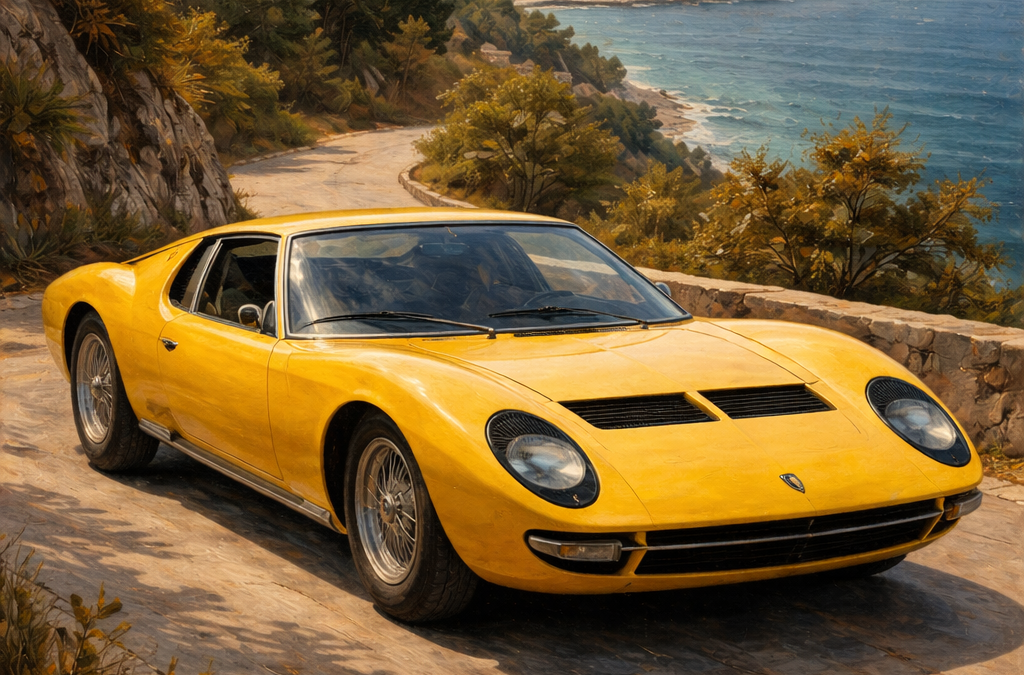
If postwar British sports cars were all about tweed, tea, and sliding around airfields, Italy looked at that and said, “Cute. Now let’s make this dramatic.”
This is the Italian golden age: when Ferrari, Maserati, and Lamborghini turned the sports car into something operatic, ruinously expensive, and occasionally on fire—but in a glamorous way.
From race shop to road gods: Ferrari finds its stride
Ferrari the company officially starts building road cars in 1947 with the 125 S, but its roots go back to Enzo Ferrari’s prewar racing team, Scuderia Ferrari, founded in 1929 to run Alfa Romeos in competition. Wikipedia
Enzo’s attitude toward road cars was charmingly blunt: they existed to fund racing. You, the customer, were essentially helping pay for his Grand Prix habit—and in return you got a car that felt only slightly detuned from something at Le Mans.
The key step toward the true Italian sports GT came in the 1950s with the Ferrari 250 series. Built from 1952 to 1964, all 250s shared the same basic heart: a 3.0-litre Colombo V12, named for engineer Gioacchino Colombo, with roughly 250 cc per cylinder (hence the “250” badge). Wikipedia+1
Within that family you get a progression that basically defines Ferrari’s golden era:
- 250 MM and 250 Export – racing berlinettas and spiders for long-distance events.
- 250 GT Berlinetta (SWB) – introduced 1959, with a short wheelbase that sharpened handling and compact Pininfarina/Scaglietti bodywork that still looks like it was drawn by a Renaissance sculptor on a very good day. Ferrari
- 250 GTO – launched 1962, a homologation special built in tiny numbers, now treated like a rolling financial instrument worth tens of millions. It married that V12 to a wind-tunnel-influenced body that dominated GT racing in the early 1960s and has since been called one of the most important Ferraris ever built. Wikipedia+2ROSSOautomobili+2
The pattern here is crucial:
Ferrari perfected the idea that a sports car could be both a racing weapon and a grand touring sculpture, equally at home on the Mille Miglia or outside a Milanese restaurant at midnight.
That “dual citizenship”—between track and boulevard—is what will define the Italian sports car all the way through the ’60s.
Maserati: from race garage to grown-up GT
If Ferrari is the fiery younger son, Maserati is the older brother who has seen some things.
The Maserati brothers began by building racing cars in the 1920s, scoring wins at events like the Targa Florio before eventually selling the company in 1937. The postwar firm kept racing—think 250F Grand Prix cars and sports prototypes—but by the mid-1950s it needed a proper road-car business to stay viable. The Cortile
Enter the Maserati 3500 GT.
Built from 1957 to 1964, the 3500 GT was Maserati’s first true series-production grand tourer. Around 2,200 were made—tiny by mass-market standards, huge for a boutique racing outfit. Wikipedia
Key ingredients:
- A detuned version of Maserati’s race-derived 3.5-litre twin-cam straight-six, originally developed for the 350S sports racer.
- Elegant, understated bodywork by Touring (and later open Spyders by Vignale)—long bonnet, tidy greenhouse, proper 2+2 seating. Wikipedia
- Serious engineering under the skin, but the whole package meant for high-speed continental cruising rather than full-time track duty.
Where Ferrari’s 250s were hot-blooded racehorses with license plates, the 3500 GT was more like an Italian fast train in coupe form—still rapid, but calmer, smoother, less obsessed with lap times.
And that matters, because it shows the sports-car concept splitting into two Italian dialects:
- The hard-edged competition GT (Ferrari 250 GT SWB, 250 GTO)
- The refined grand tourer (Maserati 3500 GT)
Both are sports cars, but they speak to different kinds of speed fantasies.
Lamborghini: the mid-engined thunderclap
Then, in 1963, along comes a tractor magnate who’s had enough of Enzo Ferrari’s attitude.
Ferruccio Lamborghini, already rich from building agricultural machinery, founded Automobili Lamborghini in Sant’Agata Bolognese because he felt Ferrari road cars were too rough and their customer service too arrogant. His original brief was actually quite sensible: powerful, comfortable front-engined GTs like the 350 GT, not temperamental race-derived machines. Anglo Scottish Finance+1
His engineering team, however, had other ideas.
In their spare time, engineers Gian Paolo Dallara, Paolo Stanzani, and Bob Wallace designed a radical mid-engined chassis purely because they thought it would be fun—and, let’s be honest, because it might annoy Ferrari. MotorTrend+1
Ferruccio eventually saw the potential and approved the project. The result, unveiled as a rolling chassis in 1965 and as a full car in 1966, was the Lamborghini Miura. Wikipedia
Why the Miura is such a big deal:
- It put a transversely mounted V12 in the middle of the car, under a gorgeously low bonnet line.
- The styling, by Marcello Gandini at Bertone, looked like something from another planet—wide, low, and impossibly sensual. Wikipedia
- With around 350 hp in early P400 form and later more in the S and SV, top speeds nudging 170+ mph, it was faster than most people’s survival instincts. Wikipedia+1
Most historians treat the Miura as the first true “supercar”: mid-engined, exotic, outrageously styled, and designed primarily to blow minds rather than win organized race series. MotorTrend+2Anglo Scottish Finance+2
If Ferrari’s sports cars were thoroughbred racehorses and Maserati’s GTs were express trains, the Miura was a low-flying jet made of anxiety and petrol.
Operatic, expensive… and occasionally on fire
Taken together, Ferrari, Maserati, and Lamborghini in the ’50s and ’60s did three crucial things to the idea of the sports car:
- They made it aspirational art.
Pininfarina’s work on the Ferrari 250 GT berlinettas and spiders, Touring’s lines for the Maserati 3500 GT, and Gandini’s design for the Miura turned sports cars into moving sculptures. These weren’t just tools for going fast; they were statements about taste, status, and what beauty on four wheels could look like. Ferrari+2Wikipedia+2 - They fused racing tech with road-car theatre.
Ferrari baked competition into almost everything it built—Mille Miglia, Le Mans, and GT championships all fed back into the 250 line. Wikipedia+2Wikipedia+2
Maserati translated its sports-racing engines into the more civilized 3500 GT. Wikipedia
Lamborghini, pointedly not a racing company at the time, instead brought the drama of racing tech—mid engines, radical packaging—onto the public road with the Miura. Wikipedia+1 - They created the template for the modern “halo car.”
These Italian sports cars were never meant to be sensible. They were expensive, often fragile, and sometimes flammable if you parked them wrong. But they made the entire brand glow. A 3500 GT in the showroom sold more mundane Maseratis by association; a 250 GTO made every lesser Ferrari feel like part of something heroic; a Miura in a magazine spread turned Lamborghini from “tractor company” into myth. Wikipedia+3Anglo Scottish Finance+3Wikipedia+3
This is the “operatic” part: these cars are not neutral objects. They are loud, emotional performances about speed, risk, and identity.
How to explain this era to a modern audience
Ferrari = race-born perfectionism.
Explain how the 250 series tied directly to motorsport success and how Enzo’s “win on Sunday, sell on Monday” mindset shaped everything from engine design to the way the cars looked.
- Maserati = the subtle alternative.
The 3500 GT showed that an Italian sports car didn’t have to shout. It could be dignified, beautifully made, and still rapid—a kind of early template for the sophisticated GT they see today in things like DB12s and Roma-type cars. - Lamborghini = pure rebellion.
The Miura is what happens when a few young engineers decide to build the car they want, not the one the boss asked for. It’s the moment the sports car becomes a supercar: form as spectacle, layout as provocation, performance as an act of defiance.
In the next chapter, we can follow this Italian arms race into the 1970s and 1980s—how emissions laws, oil crises, and changing tastes tried their best to kill the sports car, and how the concept survived anyway through turbos, wedges, and increasingly creative accountants.
Works Cited (MLA 9)
“A Journey Through Time: History of Italian Sports Car Brands.” Anglo Scottish Finance, 5 Aug. 2024. Accessed 14 Dec. 2025. Anglo Scottish Finance
“Ferrari 250.” Wikipedia, Wikimedia Foundation. Accessed 14 Dec. 2025. Wikipedia
“Ferrari Past Models.” Ferrari S.p.A., model archive. Accessed 14 Dec. 2025. Ferrari
“History of Ferrari.” Wikipedia, Wikimedia Foundation. Accessed 14 Dec. 2025. Wikipedia
“Lamborghini Miura.” Wikipedia, Wikimedia Foundation. Accessed 14 Dec. 2025. Wikipedia
“1966–1973 Lamborghini Miura: Original Influencer.” MotorTrend, 5 Feb. 2019. Accessed 14 Dec. 2025. MotorTrend
“Maserati 3500 GT.” Wikipedia, Wikimedia Foundation. Accessed 14 Dec. 2025. Wikipedia
“A Brief History of the Marques of Italia.” Cortile Pittsburgh, 12 July 2015. Accessed 14 Dec. 2025. The Cortile
“Ultimate Guide to All Ferrari 250 Models.” Rosso Automobili, 9 Aug. 2024. Accessed 14 Dec. 2025. ROSSOautomobili