

Citizen Kane and Reflections of Trump
January 19, 2026
Thank God for the Nineties!
February 15, 2026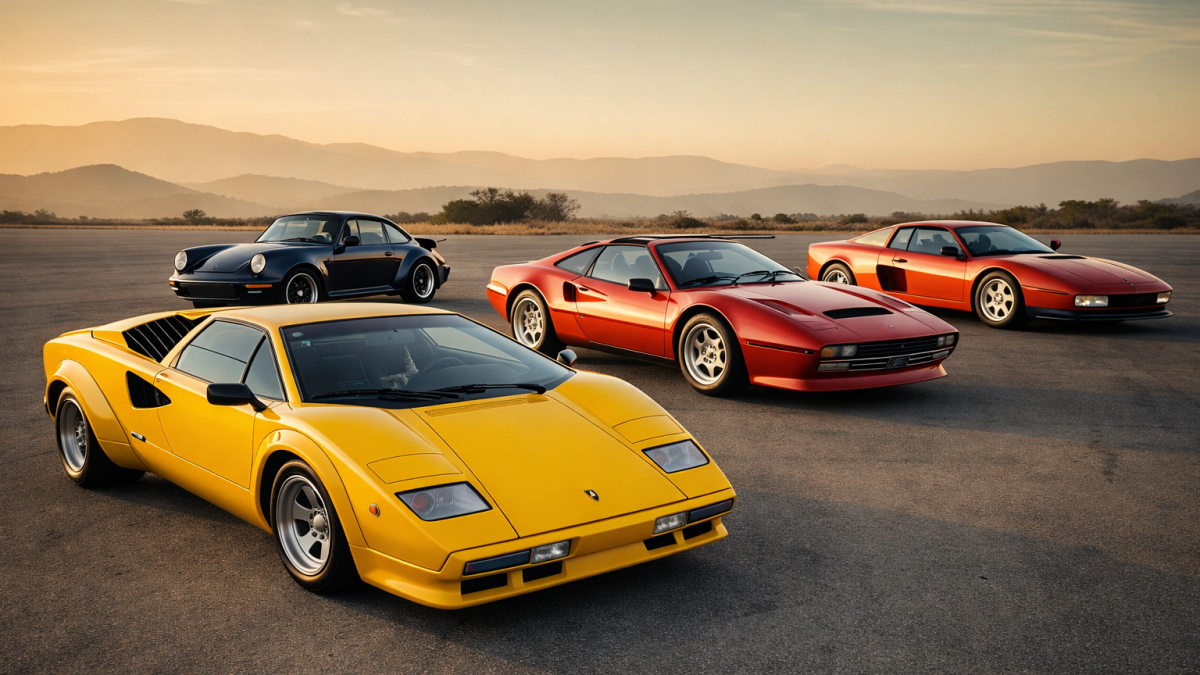
If the ’50s and ’60s were the golden age of Italian sports cars, the ’70s and ’80s were the bit where the universe asked, “Are you sure about all this?”
Oil prices quadrupled, governments started counting molecules coming out of tailpipes, insurers panicked, and suddenly the future of the sports car looked about as bright as a British Leyland wiring harness.
And yet—somehow—we got Countachs, 308s, Testarossas, and turbocharged Porsches out of it.
This chapter is about how regulations, oil shocks, and changing tastes tried to kill the sports car—and how it survived via turbos, wedge styling, and some very creative spreadsheet work.
The Hangover: Laws, Oil and the Death of Cheap Horsepower
In 1970, the U.S. passed a strengthened Clean Air Act that demanded roughly a 90% reduction in emissions from new cars by 1975. That’s not a tuning tweak; that’s open-heart surgery.
To hit those targets, manufacturers had to:
- Slash compression ratios (goodbye, high-octane fun)
- Fit catalytic converters, which required unleaded fuel and strangled exhaust flow
- Detune engines and add emissions hardware that weighed as much as a small relative
At almost the same time, the 1973 oil crisis sent fuel prices into orbit. Global oil prices roughly quadrupled; European petrol prices doubled; American buyers—previously in love with V8 anything—suddenly discovered fuel economy.
Add in new U.S. fuel-economy rules (CAFE standards) after 1975, and the message was clear: stop having fun and buy a hatchback.
So in this environment—emissions crackdowns, fuel rationing, insurance surcharges—how on earth do you justify a mid-engined V12?
You make it look like a spaceship, for starters.
Wedges Against the World: Countach and 308
The undisputed king of the wedge is the Lamborghini Countach, penned by Marcello Gandini at Bertone and built from 1974 to 1990. It took the mid-engine template of the Miura and flattened it into something so low and angular it looked like it had been run over by an architect.
Early LP400 cars were surprisingly clean: narrow body, minimal spoilers, and about 375 hp from a 3.9-litre V12. Later versions—LP400 S, LP5000, and LP5000 QV—gained ever wider arches, enormous tyres, that picnic-table rear wing, and engines up to 5.2 litres.
Why the escalation? Regulations and markets, mostly:
- U.S. emissions rules pushed Lamborghini toward fuel injection on some QV cars, trading a bit of peak power for cleaner exhausts.
- Extra weight from safety and comfort kit nudged them to keep adding displacement just to stay properly outrageous.
It’s a very 1980s solution to a 1970s problem: if the world is telling you to calm down, you turn up the volume and fit bigger carburettors.
Italy’s more “usable” answer was the Ferrari 308 GTB/GTS, launched mid-’70s as the spiritual successor to the Dino. The shape was still wedge-influenced but softer, a mid-engined V8 2-seater you could genuinely daily if you were slightly deranged.
Here the regulatory pain is obvious:
- U.S.-market 308s had heavier crash bumpers, extra reinforcements, and air pumps in the engine bay.
- To satisfy EPA and safety rules, they were detuned vs. European cars—slower, heavier, and slightly grumpy about it.
Ferrari clawed performance back with fuel-injected “i” models and later quattrovalvole (QVs), adding four-valve heads and more power. The 308’s evolution is basically a decade-long argument with the rulebook: every time legislation knocked it down, the engineers quietly slipped some performance back in.
Turbos: When Physics Becomes a Loophole
Naturally aspirated engines were struggling to deliver both power and cleanliness. The obvious answer was turbocharging—force-feeding more air into smaller engines so they could pass emissions tests at light loads and still go berserk at full boost.
The poster child here is German rather than Italian, but spiritually it’s in the same arms race: the Porsche 911 Turbo (930).
Launched in 1975, the 930 took a 3.0-litre flat-six, added turbo tech developed from Can-Am racing, and created a road car that was, at launch, the fastest production car in Germany.
It also gained the cheerful nickname “Widowmaker” thanks to epic turbo lag and a rear engine that liked to swing around and introduce itself to hedges if you lifted at the wrong moment.
The lesson, though, was powerful: you could still build a genuinely scary fast car in the age of unleaded and catalytic converters if you used boost intelligently.
Italy very much noticed:
- The Ferrari 288 GTO (1984–87) started life as a Group B homologation car, essentially a 308 turned up to 11 with a longitudinal twin-turbo V8 and about 400 PS.
- When Group B imploded in 1986 after a string of fatal accidents, the 288 never raced—but the engineering work fed directly into the even more unhinged F40.
Testarossa and the Age of Outrage
By the mid-1980s, the world had recovered from the worst of the oil panic, and financial markets were doing interesting, cocaine-flavoured things. Demand re-emerged for cars that screamed “I have arrived and may leave quickly.”
Enter the Ferrari Testarossa.
Underneath, it evolved from the flat-12 Berlinetta Boxer, but wrapped in a vast, side-straked body by Pininfarina’s Leonardo Fioravanti. Those famous cheese-grater strakes weren’t just fashion; they were a clever way to meet regulations that limited the size of open side intakes while still feeding the radiators.
Again, the regulatory thumbprint is clear:
- U.S. cars gained extra emissions kit and, in some years, slightly lower quoted power to meet local standards.
- Yet the Testarossa’s sheer visual drama—wide rear track, massive tail, that iconic name—meant nobody cared if it was a few bhp down on the Euro spec.
Design had become a weapon: even if legislation stole some power, a car that looked like the Testarossa still felt outrageous.
Creative Accountants and Halo Economics
At this point you might reasonably ask: how did these companies survive building such compromised, tiny-volume toys in an era obsessed with economy?
The short answer is: accounting, platform sharing, and halo logic.
- Ferrari spread development costs by using related platforms and engines across the 308/328, Mondial, and 288 GTO/F40 families. One parts bin, many levels of insanity.
- Lamborghini staggered Countach variants over 16 years, evolving one basic chassis and V12 rather than starting from scratch each time—cheap(ish) way to stay current while production numbers stayed in the hundreds.
- CAFE and emissions rules pushed even exotic makers to think about average fuel use and cleanliness; the trick was to offset a few thirsty halo cars with more sensible models or very low volumes.
The business case wasn’t “these cars make us rich.” It was:
These cars make our brand so desirable that people will gladly buy the tamer stuff—and we get to keep racing and designing things that look like they’ve fallen through a wormhole from the year 3000.
In that sense, the sports car survived the ’70s and ’80s by becoming rarer, more exotic, and more symbol than product.
Why This Era Still Matters
For your readers, especially younger enthusiasts raised in a world of hybrids and EVs, this period explains a lot about why sports cars look and behave the way they do now:
- The obsession with wedge shapes and wild aero came partly from a need to shout louder in a world that was telling cars to quiet down.
- The reliance on turbos as standard kit in modern performance cars has its roots in this era’s attempt to square the circle of power vs. pollution.
- The entire idea of a “halo car”—a ruinously expensive flagship that justifies the existence of the rest of the lineup—was sharpened in these years of regulatory pressure and creative accounting.
In the next chapter, we can move into the 1990s and 2000s, when a weird alliance of Japanese precision, German engineering and Italian drama rebuilt the sports car into something faster, sharper, and—occasionally—almost reliable.
Works Cited
“Ferrari 308 GTB/GTS.” Wikipedia, Wikimedia Foundation. Accessed 31 Jan. 2026.
“Ferrari 288 GTO.” Wikipedia, Wikimedia Foundation. Accessed 31 Jan. 2026.
“Ferrari 288 GTO: The Ultimate Guide.” Supercars.net, 2024. Accessed 31 Jan. 2026.
“How the 1973 Oil Crisis Changed Motoring.” Discovery UK, 13 Sept. 2023. Accessed 31 Jan. 2026.
“How the Oil Crisis and the EPA Changed the Automotive Industry.” CarBuzz, 28 Sept. 2024. Accessed 31 Jan. 2026.
“Lamborghini Countach.” Wikipedia, Wikimedia Foundation. Accessed 31 Jan. 2026.
“Lamborghini Countach: History, Generations, Specifications, Photos.” MotorTrend, 12 Aug. 2020. Accessed 31 Jan. 2026.
“Malaise Era.” Wikipedia, Wikimedia Foundation. Accessed 31 Jan. 2026.
“Porsche 911 (930).” Wikipedia, Wikimedia Foundation. Accessed 31 Jan. 2026.
“Timeline of Major Accomplishments in Transportation and Air Quality.” U.S. Environmental Protection Agency, 3 Nov. 2025. Accessed 31 Jan. 2026.
“Your Handy Ferrari Testarossa (1984–1991) Buyer’s Guide.” Hagerty, 25 Jan. 2021. Accessed 31 Jan. 2026.
“The Rise and Fall and Rise of the Ferrari Testarossa.” DriveCult, 3 Sept. 2015. Accessed 31 Jan. 2026.