
Did MIT Just Prove That Thoughts Create Reality? (Spoiler: No… But It Got Interesting.)
November 23, 2025Alan Watts Was Right About Everything (Mostly): Why His Ideas Still Matter in 2026
December 22, 2025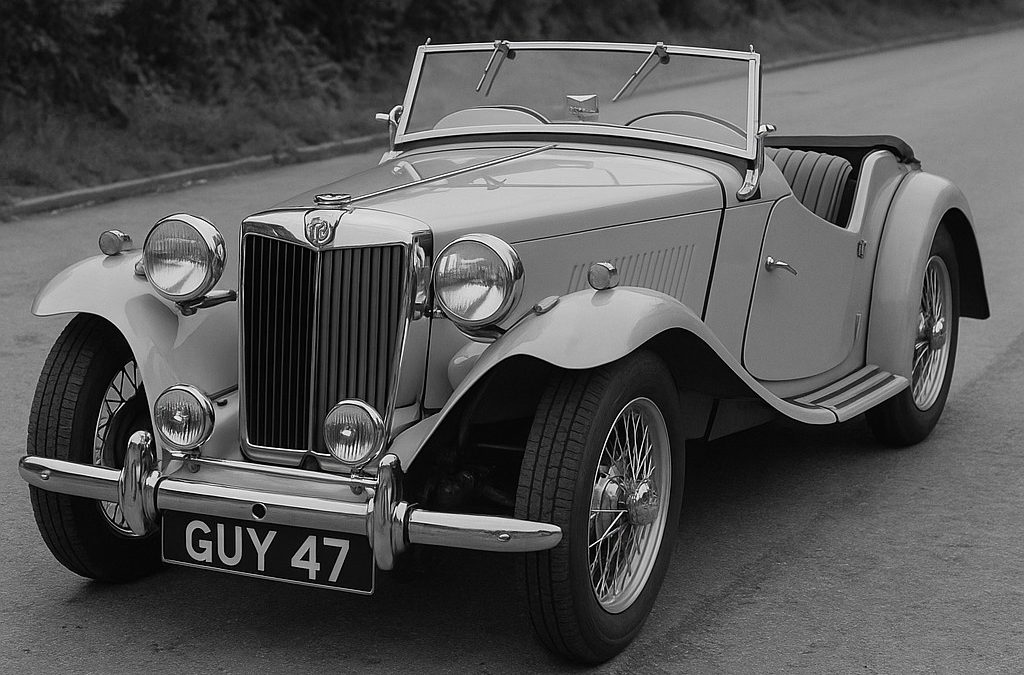
If the prewar Prince Henry cars were the Big Bang of the sports car, the years after World War II were the cosmic inflation phase—suddenly there were sports cars everywhere, and half of them seemed to be leaking oil on an American driveway.
This is the chapter where a tiny British roadster seduces returning GIs, Triumph decides MG isn’t going to have all the fun, and a family working out of a sawmill in Austria quietly invents Porsche.
1945: Big American cars, tiny British problem
In 1945, the average American car was a rolling sofa: big, soft, and about as eager to corner as a Manhattan apartment building. Europe, meanwhile, was bombed, rationed, and trying to remember what “normal life” even looked like.
Into this chaos crept a peculiar sight: little two-seat British roadsters with narrow wire wheels, leather straps, and engines that sounded like an irritated sewing machine. To American eyes accustomed to Buicks and Packards, the MG T-series looked ridiculous—like someone had tried to build a car out of garden furniture.
And yet, for a certain type of driver, they were irresistible.
The MG TC: the car that changed what American fun looked like
MG dusted off its prewar TB design, gave it a light mechanical refresh, and launched the MG TC Midget in 1945 as its first postwar sports car. It used a 1,250 cc overhead-valve four making around 54 hp—nothing spectacular on paper—but the car weighed about as much as a modern SUV’s tailgate. The result was a car that loved to be driven, not simply pointed. Road & Track+2Shannon’s Club+2
Only about 10,000 TCs were built, and roughly 2,000 came to the United States, but the numbers understate the impact. Autoweek+2facebook.com+2 Returning American servicemen had encountered MGs and other small sports cars around British airfields and villages during the war; when peace came, they either brought cars home or went looking for something that felt like that experience. As one historian of American car culture notes, the “little British sports car” became a key symbol of postwar modernity and cosmopolitan taste for a subset of young Americans. Purdue e-Pubs+1
The TC had all the practicality of a tweed jacket in a Phoenix summer:
- Right-hand drive only
- Drafty side curtains instead of proper windows
- A cockpit designed for humans before we discovered chiropractors
But that was precisely the point. It offered something American sedans didn’t: immediacy. Steering that talked to you. A gearbox that demanded you participate. A chassis that rewarded bravery and punished stupidity.
MG followed up with the TD in 1950—wider track, independent front suspension, left-hand drive for export—and then the prettier TF in 1953, essentially the last and most refined of the old-fashioned T-series line. The TD sold nearly 30,000 units, about 23,500 of them in the U.S.—proof that this “niche” enthusiasm was turning into a genuine market. Autoweek+1
In other words: a quirky little car built in Abingdon became the gateway drug to American sports-car culture.
Clubs, cones, and closed airfields: how culture formed around the cars
Cars alone don’t create culture; people and infrastructure do.
In 1944—before the war even ended—a group of enthusiasts in Boston founded the Sports Car Club of America (SCCA) as a kind of gentleman’s club dedicated to preserving and enjoying prewar sports cars. Racing Archives+1 By the late 1940s and early 1950s, as MGs and other imports trickled in, the SCCA pivoted from preservation to competition, organizing road races at places like Watkins Glen and later purpose-built circuits.
Academic work on postwar car culture points out that these early clubs and events didn’t just give owners somewhere to race; they also made the foreign sports car a social identity. To own an MG, Jaguar, or Porsche was to signal that you were worldly, modern, maybe a little bit eccentric—and willing to sit in the rain for the privilege. Purdue e-Pubs+1
So by the early 1950s you have thousands of Americans:
- Driving to work in sensible Chevrolets
- Spending weekends flogging small imported sports cars around hay-bale “circuits” on decommissioned airfields
It’s a split personality that still defines a lot of enthusiasts today.
Triumph TR2: when MG’s rival shows up with more shove
Of course, once MG had proven that Americans would buy small sports cars, every other British manufacturer wanted a slice.
The Standard Motor Company (which owned Triumph) looked at the aging Triumph Roadster and correctly concluded that it was about as competitive as a fax machine in a TikTok war. Sir John Black, Standard’s boss, asked his team to create a proper, affordable sports car aimed squarely at export markets—especially the United States. Wikipedia+1
After an unhappy prototype called the 20TS was condemned by test driver Ken Richardson as a “death trap,” Triumph went back to the drawing board. The result was the Triumph TR2, launched in 1953:
- 2.0-litre four-cylinder making around 90 hp
- Simple ladder-frame chassis
- Top speed over 100 mph, making it one of the least expensive cars capable of that magic number in period testing Wikipedia+2HowStuffWorks+2
Where the MG felt like a prewar relic with charm, the TR2 felt modern and muscular. A streamliner-equipped TR2 set a 124.9 mph record on the Jabbeke motorway in Belgium in 1953, a spectacular headline that told American buyers: this isn’t just cute, it’s properly quick. Wikipedia+1
Period road tests and later histories agree that the TR2 hit the sweet spot: faster than an MG, cheaper than a Jaguar XK120, rugged enough for daily use, and competitive in SCCA racing. MidlifeClassicCars.com+3Hemmings+3HowStuffWorks+3
Triumph had entered the game, and now Britain had a small-car arms race on its hands—which, from our perspective, is excellent.
Meanwhile, in a sawmill in Gmünd: the first Porsche
While Britain was turning out leaf-sprung roadsters, the Porsche family was trying to rebuild its business after the war. Bombing raids had made Stuttgart a poor place to design cars, so Ferry Porsche moved operations to Gmünd, Austria, setting up shop in a disused sawmill. Hemmings+1
There, in 1948, he built the first car to carry the Porsche name: Porsche 356-001, a mid-engined roadster based heavily on Volkswagen mechanicals but wrapped in a light, hand-hammered aluminum body. Hemmings+1 A small series of about fifty aluminum-bodied 356 coupes and cabriolets followed between 1948 and 1949—the famous “Gmünd Porsches.” Wikipedia+1
By 1950, production moved back to Zuffenhausen in Germany, and the 356 evolved into the rear-engined coupe and cabriolet shape we now think of as classic Porsche. Over its 1948–1965 production run, roughly 76,000 examples were built; about half survive today, and the United States quickly became the car’s largest market. Wikipedia+2Hemmings+2
The 356 brought something new to the postwar sports-car party:
- A more sophisticated, aerodynamic shape than most British rivals
- Rear-engine layout and excellent traction
- A blend of everyday usability and competition success in rallies and endurance racing
Where MG sold romance and Triumph sold speed-per-dollar, Porsche quietly began selling a philosophy: precision, engineering integrity, and the idea that a sports car could be both a tool and a companion for decades.
Why this postwar explosion still matters
If you’re talking to younger drivers who grew up in a world of crossovers and stability control—this era explains why sports cars occupy such a strange, emotional corner of our imagination.
A few key takeaways:
- The cars were answers to very human feelings.
GIs didn’t come home wanting better sedans. They wanted feeling—the contrast between wartime adrenaline and peacetime boredom. Small sports cars gave them that in a controllable, personal way (and without diving out of aircraft). Heacock Classic+2Hagerty+2 - Culture and community were as important as hardware.
Without clubs, informal racing, and the mythology built by magazines and word of mouth, the MG TC might have been a footnote. Instead, it became an icon and opened the door for Triumph, Porsche, Jaguar, and ultimately American responses like the Corvette. Velocetoday+3Racing Archives+3Undiscovered Classics+3 - The big question hasn’t changed.
Then as now, sports cars ask a slightly subversive question: Are you willing to trade comfort and practicality for engagement and joy?
Postwar buyers answered with a resounding “yes,” even if that meant driving a tiny, drafty MG in a land of V8-powered sofas.
In the next installment, we can follow this thread into the Italian golden age—Ferrari, Maserati, and Lamborghini—and watch how the idea of the sports car becomes something more operatic, expensive, and occasionally on fire.
Works Cited (MLA 9)
“America’s Love for the Little MG TC Is No Small Thing.” Hagerty, 17 Aug. 2017. Accessed 30 Nov. 2025. Hagerty
“Car of the Week: 1954 Triumph TR2.” Old Cars Weekly, 16 Feb. 2016. Accessed 30 Nov. 2025. Old Cars Weekly
“The European Sports Car and the Globalization of America.” PhD dissertation, Purdue University, 2018. Accessed 30 Nov. 2025. Purdue e-Pubs
Glad, Douglas. “A Brief History on the 356 Gmünd, the First Porsche.” Hemmings Motor News, 26 June 2023, updated 19 Dec. 2024. Accessed 30 Nov. 2025. Hemmings
“How the MG TC Ignited America’s Postwar Roadster Obsession.” Road & Track, 19 July 2021. Accessed 30 Nov. 2025. Road & Track
“MG TD – The Story of the MG That America Loved First (Part 3).” Peter James Insurance, 21 Feb. 2025. Accessed 30 Nov. 2025. Peter James Insurance
“MG TC–TD–TF: How a Tiny British Sports Car Won the First Post-War AGP.” Shannons Club, 19 Apr. 2019. Accessed 30 Nov. 2025. Shannon’s Club
“Porsche 356.” Wikipedia, Wikimedia Foundation, last modified 2025. Accessed 30 Nov. 2025. Wikipedia
“The Sports Car Club of America (SCCA) and Early Postwar Sports Car History.” Racing Archives Foundation and Undiscovered Classics, 23 June 2020. Accessed 30 Nov. 2025. Undiscovered Classics+1
“Triumph TR2.” Wikipedia, Wikimedia Foundation, last modified 2025. Accessed 30 Nov. 2025. Wikipedia
“The Birth of the Twos – Triumph TR2 Roadster.” Hemmings, 27 Aug. 2024. Accessed 30 Nov. 2025. Hemmings