
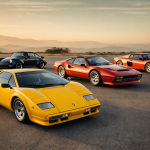
When Wedges and Turbos Saved the Sports Car
February 1, 2026
Danger, Will Robinson!
February 23, 2026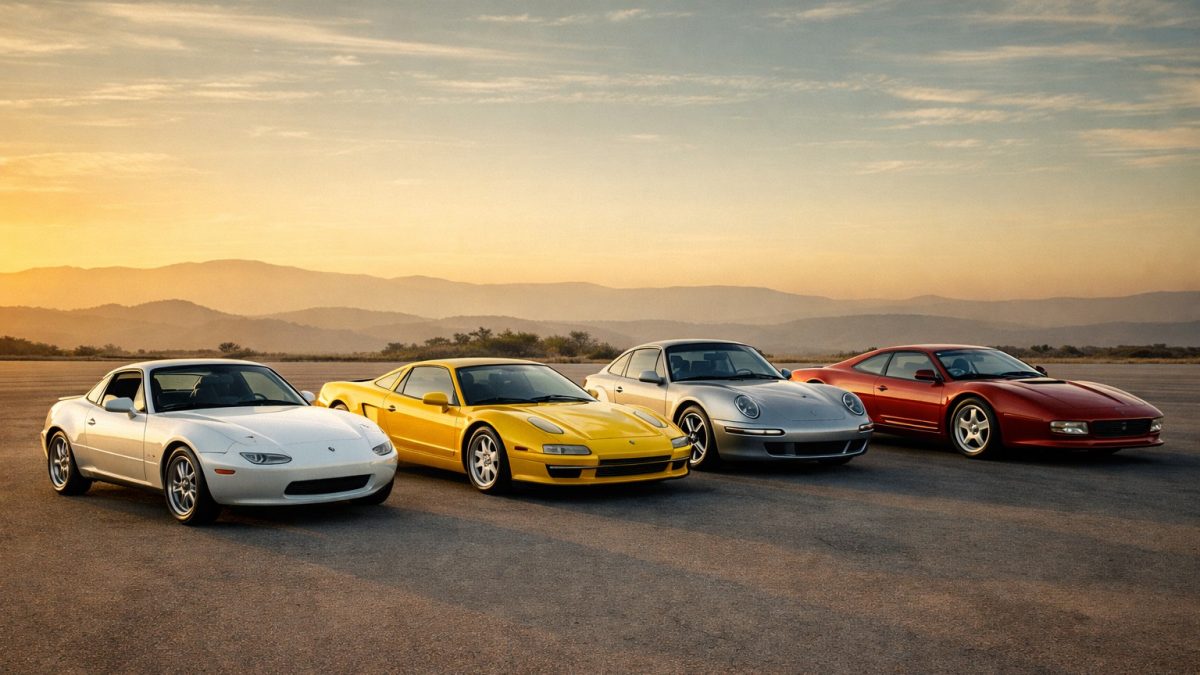
By the time the 1990s rolled around, the sports car looked like it might go the way of VHS and mullets—fondly remembered, but not something you’d actually use in public.
Then something unexpected happened.
Japan showed up with scalpel-sharp engineering and shocking reliability, Germany doubled down on precision, and Italy learned (more or less) how to build drama that didn’t catch fire or fall apart immediately. Out of that weird alliance, the modern sports car was rebuilt: faster, sharper, and—on a good day—almost reliable.
Japan: When the Samurai Brought a Torque Wrench
Mazda MX-5 Miata – the return of the “proper” sports car
In 1989 Mazda did something quietly radical: it brought back the small, simple, front-engined roadster the British had essentially abandoned. The first-gen Mazda MX-5 (NA) arrived with pop-up headlights, a 1.6-litre four-cylinder, rear-wheel drive, and not much else—and that was the point.
Mazda’s engineers built the car around the philosophy of jinba ittai—“horse and rider as one”—a mantra they still invoke every time they talk about the Miata. Keep it light, keep it communicative, and make every control feel like an extension of the driver. The NA weighed around a tonne, had double-wishbone suspension at all four corners, and made maybe 115–130 hp depending on market. It didn’t need more.
Most importantly, it worked. Where an MGB or Spitfire could be relied upon to introduce you to the concept of roadside repair, the Miata offered:
- Modern rust protection
- Japanese build quality
- A gearbox that felt like a rifle bolt instead of a vague suggestion
It revived the roadster segment worldwide and made the idea of a cheap, reliable sports car credible again.
Honda NSX – the everyday supercar
If the Miata was the people’s champion, the Honda NSX was the samurai blade aimed directly at Maranello.
Launched in 1990, the NSX combined an all-aluminium chassis, a high-revving VTEC V6, and obsessive chassis tuning—much of it refined with input from Ayrton Senna, who helped Honda develop the car at Suzuka.
Where traditional supercars demanded sacrifices (noise, heat, random electrical moods), the NSX offered something shocking for the era:
- World-class performance
- Superb visibility and ergonomics
- Honda-grade reliability and service intervals
Modern retrospectives all hit the same note: the NSX proved you could have a mid-engined exotic that didn’t behave like an abusive relationship with leather seats.
Between the Miata at one end and the NSX at the other, Japan effectively re-wrote the social contract: a sports car could be joyous and dependable. That raised the bar for everyone else.
Germany: The Engineers Discover Feelings
Porsche 993 and 996 – from last air-cooled to first truly modern 911
In the mid-1990s, Porsche realised it couldn’t keep building slightly updated 1960s architecture forever. The 993-generation 911 (1994–98) was the last air-cooled car, heavily re-engineered with new suspension, better refinement, and the first properly sorted multi-link rear end. It’s now worshipped as the sweet spot between classic feel and usable modernity.
Then came the controversial one: the 996. Introduced in 1997, it was the first 911 with a water-cooled flat-six. Porsche redesigned the car from the ground up to meet stricter emissions, noise, and packaging demands, using commonality with the new Boxster to keep costs sane.
Enthusiasts moaned about the headlights and the loss of air-cooled character, but in exchange you got:
- More power and efficiency
- Better cabin ergonomics
- Safety and durability that allowed people to daily a 911 without feeling like a test pilot
The 993 and 996 together show the German half of this story: the sports car becoming a genuinely global product—engineered to start in the morning, pass emissions in California, and still be fun on the Nürburgring.
BMW M3 – the track toy you could take to the supermarket
Meanwhile, over in Munich, BMW was turning its compact 3-Series into something you could both flog around a circuit and park outside a grocery store without looking entirely deranged.
The E36 M3 of the early ’90s delivered high-revving straight-six power with everyday usability—reviewers still praise it as a near-perfect blend of performance, balance, and reliability for a 1990s car.
Its successor, the E46 M3 (2000–06), sharpened that formula with more power, a chassis that enthusiasts still call “nearly perfect” on both road and track, and the ability to do school runs during the week and track days at the weekend.
You can frame the ’90s/2000s German contribution like this:
Japan proved a sports car could be reliable; Germany proved it could be your only car—commuter, family duty, and track addict all in one slightly over-engineered package.
Italy Grows Up (A Bit)
Ferrari F355 and 360 Modena – drama with a warranty
By the early ’90s, even Ferrari knew it couldn’t survive on temperamental charisma alone. The Ferrari F355 (1994–99) is widely credited with turning the brand around, both dynamically and commercially. It took the slightly wayward 348 and transformed it with a 40-valve V8, better aerodynamics, and a chassis that worked at sane speeds, not just on fantasy Fiorano laps.
It was also the first road car to offer an F1-style paddle-shift gearbox (from 1997), bringing semi-automatic technology straight from the pit lane into rush-hour traffic.
Then came the 360 Modena in 1999, and this is where the “almost reliable” part gets real. The 360 introduced a full aluminium monocoque chassis, developed with Alcoa, that was 40% stiffer and around 28% lighter than the steel structure of the F355 despite being physically larger. Contemporary commentary on the 360 makes a key point: it was the first mid-engined V8 Ferrari that felt like you could actually own it, not just occasionally visit it between service bills.
Ferrari didn’t lose the drama—screaming V8, Pininfarina curves, gated manual option—but it added:
- Longer service intervals
- More robust electronics
- Real attention to build quality
For people who’d previously treated Ferraris like temperamental art installations, this was a revelation.
Lamborghini Diablo and Murciélago – from poster car to functional weapon
On the wilder side of Italy, the Lamborghini Diablo carried the V12 torch from 1990 to 2001. It kept the outrageous looks and mid-engined layout of the Countach but was deliberately easier to live with: more interior space, power steering on later cars, and, eventually, all-wheel drive on the VT models to tame the handling.
Its successor, the Murciélago (2001–10), launched under Audi ownership and represented a clear push toward refinement without losing lunacy. It packed a 6.2-litre V12 with around 580 PS at launch, all-wheel drive, and a 0–62 mph time around 3.8 seconds—supercar numbers, but wrapped in a car that reviewers praised for being vastly more solid and usable than older Lambos.
In other words: still theatre, still scissor doors, but now you could plausibly drive it more than twice a year.
The New Template: Faster, Sharper, Almost Sensible
Put all of this together and you can see why the 1990s and 2000s are such a turning point:
- Japan proved that sports cars didn’t have to be fragile or temperamental. The Miata made fun accessible; the NSX showed that even supercars could be engineered with the same care as a Civic.
- Germany turned the sports car into something multi-role: 911s and M3s that could do school runs, autobahn blasts, and track days with equal credibility.
- Italy finally balanced drama with durability, using aluminium structures, electronic gearboxes, and serious quality control to produce cars that still looked like opera posters but no longer behaved like props from a tragedy.
The takeaway is simple:
By the early 2000s, the sports car had evolved from a slightly ridiculous toy into a global product: engineered in spreadsheets, tuned on race tracks, shaped in wind tunnels—and still capable of making your heart do stupid things.
In the next chapter, we can walk into the modern era: how electronics, hybrids, and now EVs are forcing the sports car to reinvent itself again—and whether a car with no engine noise can still make your soul light up like a V12 at 8,000 rpm.
Works Cited
“Ferrari 360 Modena Specifications.” SBR Engineering, 29 June 2025.
“Ferrari 360 Modena & 360 Spider.” Supercar Nostalgia, 11 Jan. 2022.
“Ferrari F355.” Wikipedia, Wikimedia Foundation.
“F355: 25 Years of Ferrari’s Modern Classic.” Adrian Flux – Influx, 2019.
“Honda NSX: The Supercar That Redefined Everyday Performance.” Heritage Drive, 2026.
“The Honda NSX: The Ayrton Senna-Approved Everyday Supercar.” GQ, 6 July 2020.
“Mazda MX-5 (NA).” Wikipedia, Wikimedia Foundation.
“The History of the Iconic Mazda Miata.” Mazda of Raleigh, 31 Mar. 2024.
“Mazda MX-5 Miata Fans: Jinba Ittai.” Mazda USA, corporate site.
“Porsche 911 (993).” Wikipedia, Wikimedia Foundation.
“The 996: First 911 with Water-Cooled Flat Engine.” Porsche Newsroom, 25 Nov. 2018.
“Porsche 993 vs. Porsche 996: The Definitive Evolution of the 911.” Design911 Blog, 11 Oct. 2024.
“BMW E36 M3: Why Car Enthusiasts Love It.” Road & Track, 17 Dec. 2021.
“BMW E36 M3 vs. Acura NSX: ’90s Power-Density Showdown.” CarBuzz, 22 Nov. 2025.
“BMW E46 M3 Track Test: 20 Years Later, Still Competitive?” Grassroots Motorsports, 17 June 2025.
“Essential E46 M3 Track Day Mods and Guide.” The Build Journal, 23 Sept. 2020.
“Is E46 M3 a Good Daily?” E46Fanatics Forum, 2023.
“Ferrari Modena History.” FerrariModena.com.
“Buyers’ Guide – Ferrari 360.” The Stable, 19 May 2021.
“Ferrari 355 First Car with Flappy Paddle Gearbox.” CarBuzz, 31 Dec. 2024.
“Lamborghini Diablo.” Wikipedia, Wikimedia Foundation.
“Lamborghini Diablo: Everything You Need to Know.” MotorTrend, 24 Dec. 2024.
“Lamborghini Murciélago.” Wikipedia, Wikimedia Foundation.
“Lamborghini Murciélago: The First V12 of the New Millennium.” Automobili Lamborghini Newsroom, 22 Sept. 2022.
“Lamborghini Murciélago Specs, Price, Photos & Review.” duPont Registry, 28 Dec. 2023.
“Honda Launches New Parts Support for Classic NSX.” The Sun, 2025.