

Danger, Will Robinson!
February 23, 2026
Are We Too Confused to Know the Difference?
March 10, 2026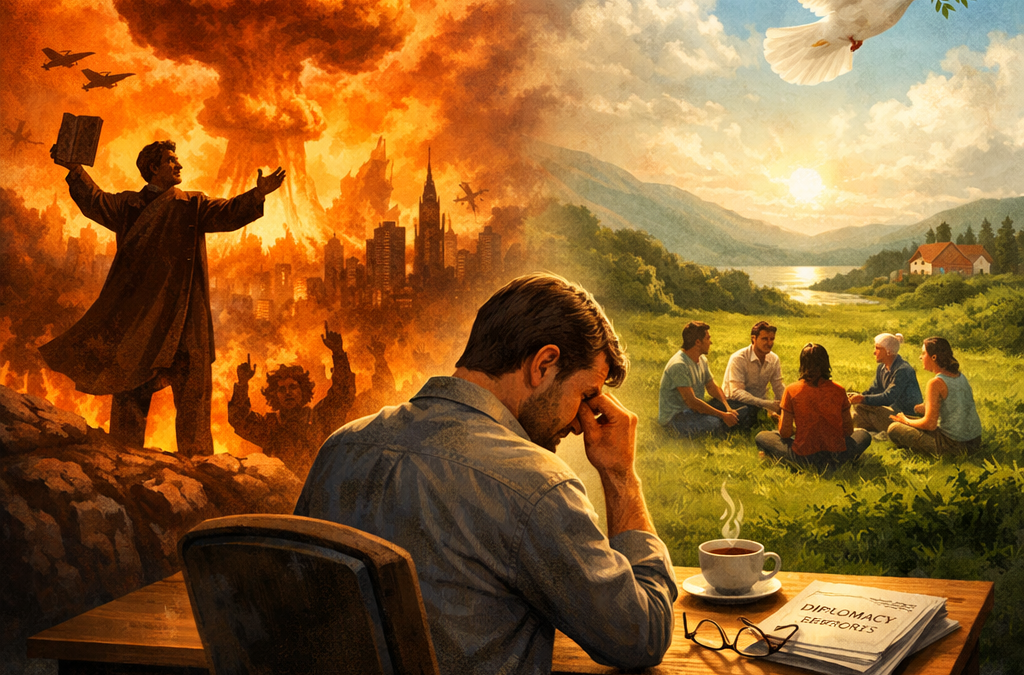
There are seasons in public life when one begins to suspect that some of the adults in the room are not, in fact, adults at all, but failed prophets with security clearances.
You see it in the tone before you see it in the policy: the swelling rhetoric, the moral melodrama, the weirdly eager flirtation with catastrophe. War is no longer described as a tragic last resort, but as a stage on which history may finally become meaningful. One can almost hear the background music. Apparently, diplomacy is for cowards, nuance is for the weak, and mass death is just another way of feeling spiritually important.
This is not merely bad politics. It is bad theology, bad psychology, and very bad civilization.
Any worldview that begins to hunger for apocalypse should be treated with the same suspicion we reserve for a man who grins while smelling smoke in a crowded theater. It does not matter whether the language is explicitly religious, nationalistic, ideological, or some mutant hybrid of all three. The mechanism is the same: ordinary human suffering is abstracted into destiny, and actual people become props in someone else’s cosmic screenplay.
That is where the real danger lies.
The most reckless people in history have rarely announced themselves by saying, “I would like to destroy the world.” They tend to say something much nobler. They say they are defending truth, restoring greatness, fulfilling destiny, or standing on the side of God. It is amazing what horrors can be smuggled into public life once enough people agree to call them sacred.
So what does one do when politics begins to sound like end-times fan fiction written by men who were never told “no”?
First, we drag everything back to earth. Back to consequences. Back to bodies. Back to hospitals, refugees, shattered families, traumatized children, economic ruin, and the sort of grief that never gets included in triumphant speeches. Any political imagination that cannot hold the human cost of war does not deserve the word moral anywhere near it.
Second, we insist that public policy remain public policy. People are free to believe whatever they wish about prophecy, providence, destiny, angels, empires, or the secret choreography of history. They are not free to use the machinery of state to impose private eschatology on millions of unwilling people. If leaders want to make the case for war, they should be required to do so in evidence, law, and sober strategic terms—not in fever dreams dressed up as courage.
Third, we defend the most unglamorous virtues in the world: restraint, verification, negotiation, oversight, patience, and the ability to resist turning every international crisis into a metaphysical showdown. These are not exciting qualities. They do not trend well. They do not make for stirring cinema. But they are the habits that keep civilizations alive.
Fourth, and perhaps most importantly, we refuse to let the apocalyptic imagination colonize our own minds. That may be the hardest part. Because panic is contagious. Grandiosity is contagious. Doom is contagious. There is always a temptation to answer fanaticism with equal and opposite fanaticism. But if we become addicted to catastrophe too—if we begin to need the crisis for our own sense of drama—then we are not resisting the sickness. We are merely choosing a different costume.
The task, then, is not only political but spiritual in the broadest sense. We must become harder to manipulate. Harder to inflame. Harder to recruit into the romance of destruction.
This means cultivating an adult moral imagination—one that sees war not as purification, but as failure; not as destiny, but as consequence; not as evidence of righteousness, but as proof that human beings are still dangerously susceptible to myth when myth flatters their fear and ambition.
I realize this is terribly inconvenient. It is much easier to believe history is a grand script and that one’s own tribe has been cast in the starring role. It is far less thrilling to admit that civilization depends mostly on fallible people doing tedious, decent things at the right moment.
But there is a kind of courage in tedium. A kind of heroism in refusing spectacle. A kind of moral seriousness in saying, over and over again, that the world is not improved by those who long to set it on fire for meaning.
If there is any hope at all, I suspect it lives there: in citizens who remain lucid when others become feverish, in leaders who still understand restraint, and in ordinary people who decline the seductive invitation to baptize chaos.
The apocalypse has always had a better publicity team than peace.
That does not mean it deserves to win.