
War for Rapture?
March 3, 2026
Hope Is Not Dead. It’s Just No Longer Cheap.
March 16, 2026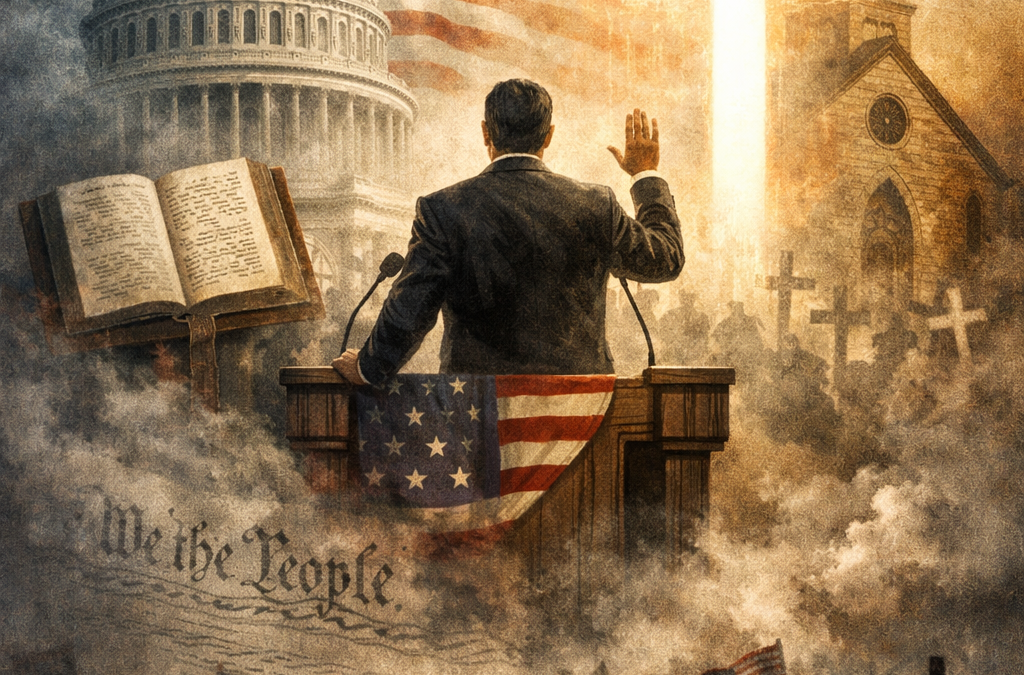
There is a strong case to be made that our understanding of religion has become so diluted, sentimentalized, and intellectually malnourished that it now serves as ideal fog cover for politicians eager to blur the line between church and state. In other words, we have not merely lost theological seriousness; we have made ourselves easier to manipulate.
That is the heart of it.
A great many people no longer seem to understand religion as a force that should humble power, discipline the ego, and place all earthly authority under moral judgment. Instead, religion is increasingly treated as lifestyle décor for the soul, a collection of slogans, a badge of tribal belonging, or a vague emotional perfume sprayed over whatever political project one already wanted to support. Once that happens, the game is nearly over. A politician no longer needs wisdom, integrity, or even constitutional restraint. He simply needs the right posture, the right buzzwords, and a willingness to stand in front of a flag while implying that God has taken a special interest in his polling numbers.
And there, of course, is the rot.
When religion becomes shallow, politics can dress up in its clothes with embarrassing ease. The result is not faith entering public life in any noble sense. It is something much tawdrier: a fusion of nationalism, grievance, nostalgia, image-making, and sanctimony. God becomes less the ground of being than the mascot of a voting bloc. Scripture becomes less a source of moral challenge than a prop. Prayer becomes less an encounter with transcendence than a photo opportunity for men who would struggle to locate the Beatitudes without staff assistance.
This is not merely bad religion. It is bad citizenship.
The constitutional line between church and state depends, in part, on a population capable of understanding why that line exists. It was never designed to protect the state from religion alone; it was designed to protect religion from the state as well. It was meant to prevent the machinery of government from hijacking the sacred for its own purposes. But that requires civic intelligence, historical memory, and at least a passing acquaintance with the difference between faith and propaganda. Those are precisely the qualities modern political culture has been grinding into powder.
So now we live in a world where many citizens appear to think “religious freedom” means “the government should endorse the religious symbols and assumptions I happen to like.” That is not religious freedom. That is religious favoritism wearing a powdered wig and pretending to be James Madison. And because so many people are theologically undernourished and constitutionally illiterate, the fraud works rather well.
A serious religion should be dangerous to politicians. It should remind them that they are finite, fallen, morally accountable creatures, not messiahs in red ties or blue ties. It should resist the worship of leader, party, nation, and spectacle. It should call out lies, vanity, cruelty, greed, and idolatry wherever they appear. But once religion is reduced to identity theater, it loses all of that force. It no longer judges power. It flatters it. It no longer disturbs the comfortable. It canonizes them.
That is why the confusion matters so much.
The problem is not that religion has too much influence. The problem is that what often passes for religion is no longer substantial enough to resist political corruption. It has been hollowed out, branded, simplified, and weaponized. It has become a useful haze in which almost any authoritarian impulse can wrap itself in the language of virtue. And people, desperate for certainty and symbolism, too often applaud.
So yes, I think it can absolutely be argued that a confused and diluted understanding of religion makes it easier for politicians to blur the line between church and state. More than that, I think it helps explain why so many citizens fail to notice the blurring until the paint is practically dry.
And that is the truly unsettling part. A nation does not lose its bearings only through force. Sometimes it loses them because enough people can no longer tell the difference between reverence and performance, between moral seriousness and theatrical piety, between God and a politician clever enough to borrow His vocabulary.