

The Constitution Is Not an Optional User Agreement.
March 26, 2026
They Call It Christianity. I Call It a Power Project.
April 29, 2026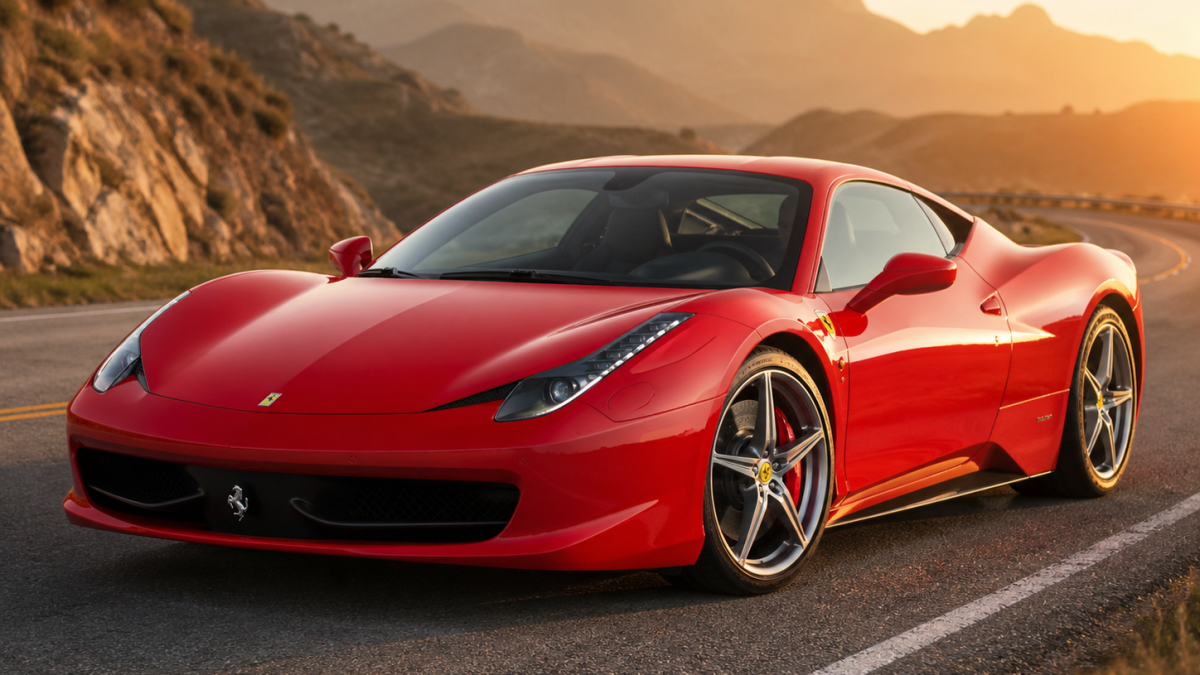
There are many ways to enter Ferrari ownership. Some are romantic. Some are reckless. Some are financially masochistic. And then there is the Ferrari 458, which may be the rare case of a first Ferrari that is both thrilling and, by Ferrari standards, relatively sane.
If one were forced to make the argument for the best first Ferrari for a beginner with serious intent and sufficient budget, a low-mileage, well-maintained Ferrari 458 would be very near the top of the list. Not because it is cheap — it certainly is not — and not because it is without risk — no Ferrari truly is — but because it occupies an unusually sweet spot in the Ferrari universe. It is modern enough to be usable, dramatic enough to feel properly exotic, and significant enough to carry genuine long-term enthusiast respect.
That combination is rarer than people think.
The first mistake many beginners make is assuming that the best first Ferrari is the cheapest one with a prancing horse on the nose. It is not. In fact, that is often the gateway to disappointment. The least expensive Ferrari on the market is frequently the least expensive for a reason: deferred maintenance, patchy records, cosmetic shortcuts, looming mechanical issues, or simply a model that does not fully deliver the emotional experience the buyer hoped for. The buyer tells himself he has entered the Ferrari world. What he has actually entered is a negotiations seminar with a service department.
The 458 avoids much of that trap. It is expensive in a more honest way.
What makes the 458 so compelling as a first Ferrari is that it feels like a Ferrari should feel. That sounds obvious, but it matters. A first Ferrari should not merely be fast. Lots of cars are fast. It should feel theatrical, alive, and a little bit irrational in exactly the right way. The 458 does. The styling is dramatic without being overwrought, the cabin still feels like an event, and the naturally aspirated V8 produces one of the great modern Ferrari soundtracks. It has the sort of vocal intensity that reminds you why turbocharging, however efficient, often feels like the beginning of compromise.
That naturally aspirated engine is not a trivial point. The 458 increasingly represents the end of an era — a Ferrari from the last generation before the brand moved deeper into turbocharged V8s and ever more filtered performance. For collectors and enthusiasts alike, “last of the naturally aspirated V8 Ferraris” is the sort of phrase that tends to age well. A first-time buyer may not think of himself as a collector yet, but he would be wise to buy with at least one eye on future desirability. The 458 offers that.
It also offers usability, and this is where it becomes particularly strong as a first Ferrari. A beginner does not always want his first experience with the marque to feel like caring for a temperamental aristocrat who resents being awakened. The 458 is modern enough to start, drive, stop, and behave with a level of civility that makes ownership less intimidating. It still feels special — crucially so — but it does not demand that the owner become an amateur archaeologist of 1980s Italian electrical systems merely to enjoy a Saturday morning drive.
That usability is one reason the car has such broad appeal. It can satisfy the emotional buyer, the driver, and even the cautious collector. It is not so old that it feels fragile, and not so new that it feels like just another very expensive performance appliance. That middle ground is where many first-time Ferrari buyers ought to be looking.
Now, none of this means that every 458 is automatically a brilliant buy. That would be foolish. Condition matters more than mythology. A mediocre 458 with incomplete service history, questionable repairs, deferred maintenance, or the wrong prior ownership story is still a bad Ferrari purchase. The phrase “low mileage” is attractive, but mileage alone proves very little. A low-mileage Ferrari that sat neglected can easily be more troublesome than a properly exercised and meticulously maintained example with somewhat higher miles. What matters is the whole picture: records, servicing, originality, inspection results, specification, and evidence of competent stewardship.
That last word matters: stewardship. Ferraris are not merely bought; they are inherited for a time. A first Ferrari buyer who understands that will usually do better than the one who shops only by color, mileage, and the seller’s confidence level.
Of course, a fair argument must include the other side. The 458 is not the best first Ferrari for everyone. The entry price alone puts it beyond the reach of many sensible beginners. And even for those who can afford it, there is a reasonable argument for beginning with a strong 360 or F430, learning the ownership culture, and then moving upward. Some buyers do not need to begin at the deep end of the pool. Others do. It depends on their resources, temperament, and how much compromise they are willing to tolerate.
Still, if the question is not “What is the cheapest first Ferrari?” but rather “What is the best all-around first Ferrari for someone who wants the real Ferrari experience without plunging straight into vintage complexity or bargain-basement regret?” then the 458 becomes a very persuasive answer.
It has beauty. It has sound. It has pace. It has presence. It has enough modernity to be enjoyed with confidence and enough old-school Ferrari character to feel like something more than a machine. Most important, it has that elusive quality every first Ferrari should have: it confirms the dream rather than correcting it.
And for a beginner, that may be the point of the whole exercise.