

They Call It Christianity. I Call It a Power Project.
April 29, 2026AI Porn and the New Crisis of Impossible Bodies
May 26, 2026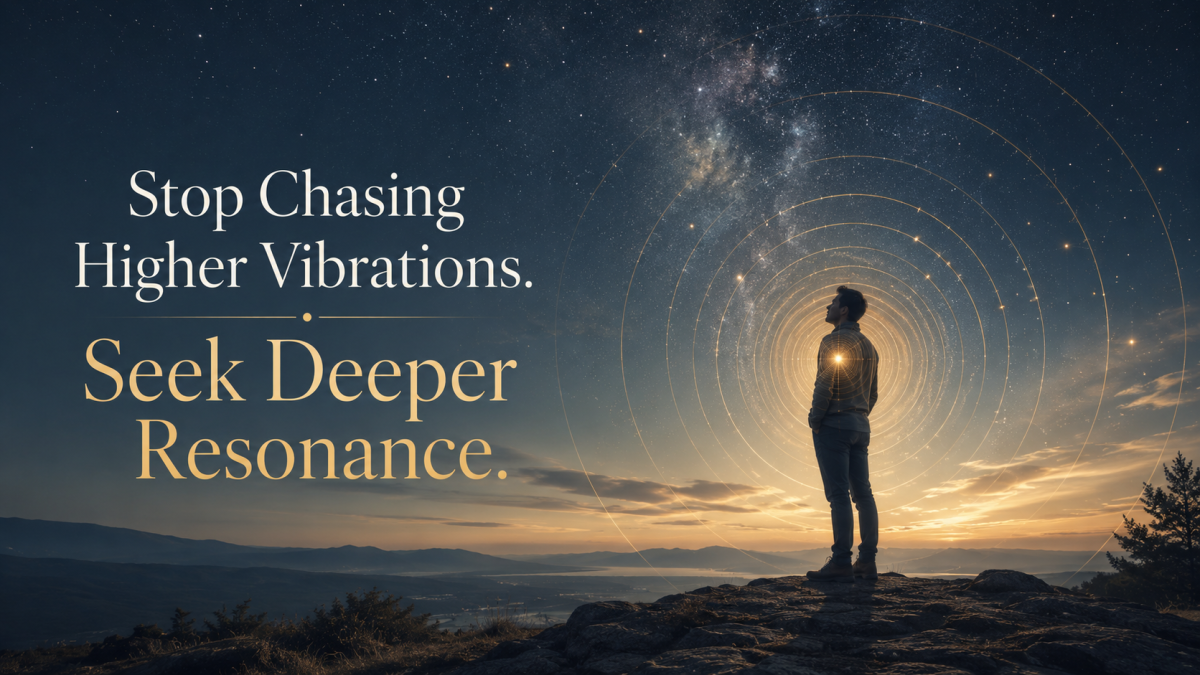
There is a phrase I keep hearing in spiritual and self-help circles: “Raise your vibration.”
At first glance, I understand the appeal. It sounds hopeful. It suggests that we are not fixed creatures, trapped forever in fear, resentment, grief, exhaustion, or despair. It implies that consciousness can change. That our inner state matters. That we might become more receptive to beauty, meaning, compassion, and perhaps even something larger than ourselves.
So I do not dismiss it entirely.
But I do think the phrase has become dangerously lazy.
Too often, “higher vibration” is used as a spiritual shortcut. It becomes a way of ranking people: the enlightened versus the negative, the evolved versus the wounded, the “high vibe” versus the poor souls still dragging around grief, anger, trauma, and doubt.
That is not wisdom. That is vanity dressed in linen.
The deeper problem is that “higher vibration” often encourages people to exile the very emotions that may be trying to tell them the truth. Anger is not always spiritually inferior. Sometimes anger is the soul’s alarm system. Grief is not a failure of consciousness. Sometimes grief is proof that love was real. Melancholy is not necessarily “low vibration.” Some of the most beautiful art ever created came from sorrow, longing, and confrontation with mortality.
If Beethoven, Blake, Van Gogh, Mary Shelley, and Dostoevsky had all been instructed to “stay high vibe,” civilization would be immeasurably poorer.
The issue is not whether we feel darkness. The issue is whether darkness drives the car.
I would rather speak of resonance than vibration.
“Higher vibration” implies a vertical hierarchy: up is good, down is bad. Resonance suggests something more subtle: harmony, depth, coherence, attunement. It asks a better question.
Not: Am I vibrating high enough?
But: Am I in alignment with what is true, beautiful, courageous, and useful?
That question matters because our inner state does shape our experience. When we are anxious or ashamed, the world narrows. We scan for threat. We miss beauty. We misread other people. We become reactive.
When we are grounded, attentive, and morally awake, the world opens. We notice patterns. We hear music differently. Art reaches us. Nature becomes less like scenery and more like presence. We become capable of awe again.
That is not pseudo-science. That is the lived reality of consciousness.
But we should be careful before turning this into cosmic bookkeeping: “I was positive, so the Universe rewarded me,” or “I suffered, so I must have attracted it.” That way lies cruelty. It turns spirituality into a customer rewards program.
A more humane practice would be this:
Do not try to float above your life.
Enter it more honestly.
Do not deny fear.
Listen to it, then refuse to let it rule.
Do not shame grief.
Let it deepen you.
Do not worship positivity.
Cultivate clarity.
Perhaps the goal is not to become a permanently cheerful person. Perhaps the goal is to become a more coherent one.
More awake.
More honest.
More compassionate.
More disciplined.
More receptive to beauty.
More willing to act.
That, to me, is deeper resonance.
And if there is a Universe trying to speak to us — through conscience, art, mystery, silence, nature, synchronicity, or the strange ache of being alive — then perhaps it does not require us to be “high vibe.”
Perhaps it requires us to be available.
Not perfect.
Not purified.
Not untouched by suffering.
Just available.
That may be the beginning of real spiritual life: not escaping the human condition, but tuning ourselves deeply enough to hear what it has been trying to say all along.