
AI Porn and the New Crisis of Impossible Bodies
May 26, 2026
AI Agents and the End of Innocent Technology: What Every Citizen Needs to Understand Now
June 30, 2026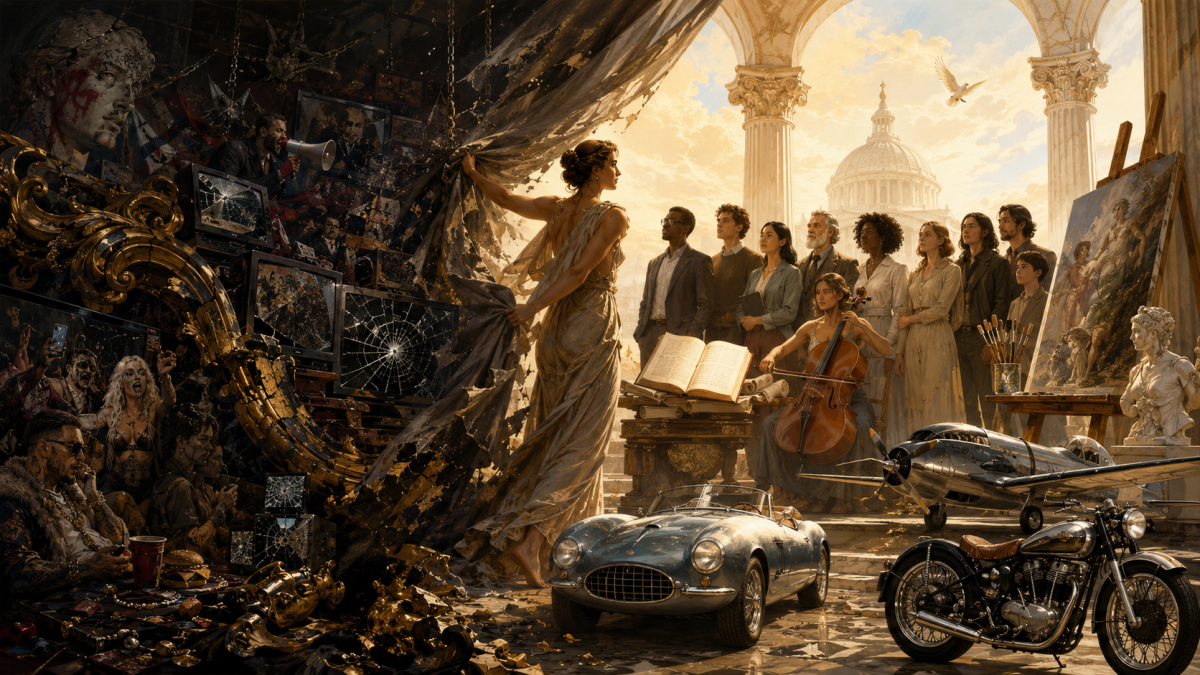
America does not merely need a political correction. It needs a cultural rebirth.
The crisis of the Trump era is not only that it has encouraged authoritarian habits, cruelty toward the vulnerable, contempt for education, and hostility toward equality. It is that it has made vulgarity aspirational. It has taught millions of people that ignorance is authenticity, that cruelty is strength, that wealth without taste is success, and that public life need not answer to beauty, truth, learning, or decency.
That is the deeper wound.
A civilization can survive policy mistakes. It cannot survive the enthronement of stupidity.
The current administration’s attacks on diversity, equity, education, civil-rights enforcement, and arts funding are not isolated bureaucratic moves. They are symptoms of a larger contempt for the humane disciplines: history, literature, philosophy, art, music, civic education, and moral imagination. Recent efforts to scale back the Department of Education and transfer key responsibilities such as civil-rights enforcement and special-education oversight have raised serious concerns among education and disability-rights advocates. The administration has also targeted DEI programs across federal agencies and contracts, prompting lawsuits from multiple states. The National Endowment for the Humanities itself stated in 2025 that it had canceled awards conflicting with administration priorities, including projects involving DEI and environmental justice.
This is not conservatism in any noble sense. Real conservatism preserves civilization. This is vandalism dressed up as patriotism.
A new Renaissance must therefore be unapologetically civilizational. It must say that art matters. Education matters. Intellectual seriousness matters. Equality matters. Craft matters. Beauty matters. The shape of a fender matters. The curve of a violin matters. The rhythm of a sentence matters. The moral imagination of a people matters.
We need a rebirth of the cultivated human being.
Not the snob. Not the technocrat. Not the influencer. Not the billionaire barbarian with gold fixtures and no soul. The cultivated human being: someone who can think, feel, build, judge, create, repair, argue, listen, and recognize beauty when it appears.
This Renaissance must resist two forms of decadence at once.
First, the decadence of vulgar wealth: the worship of money without taste, power without restraint, celebrity without accomplishment, and masculinity without honor.
Second, the decadence of passive despair: the belief that because the culture is degraded, nothing can be done.
Both are forms of surrender.
The old Renaissance was not merely a revival of painting and sculpture. It was a rediscovery of human possibility. It returned to classical forms not because the past was perfect, but because the past contained standards: proportion, harmony, discipline, civic virtue, eloquence, architecture, philosophy, and the dignity of the human figure.
That is what we need now.
A New Renaissance would not mean copying Greece, Rome, Florence, or Enlightenment Europe. It would mean recovering the idea that human beings are meant to be more than consumers, trolls, spectators, and political tribesmen.
It would mean music that remembers structure and transcendence.
It would mean movies that recover myth, moral conflict, visual intelligence, and human depth instead of endless franchise noise.
It would mean paintings and photography that restore the eye to reverence.
It would mean architecture that stops insulting the soul.
It would mean education that teaches students not merely to get jobs, but to become fully awake human beings.
It would mean automobiles, airplanes, and motorcycles understood not merely as machines, but as moving sculpture: expressions of courage, elegance, speed, engineering, and desire.
This is where the neoclassical instinct becomes powerful.
A neoclassical approach does not mean sterile imitation. It means discipline joined to beauty. It means form. It means proportion. It means the refusal to confuse chaos with originality. It means a Ferrari 250 GTO, a Ducati 916, a Jaguar E-Type, a Spitfire, a Porsche 356, a Vincent Black Shadow, a Bugatti Type 35, a P-51 Mustang, a Lancia Stratos, a Norton Manx, a Shelby Cobra. Machines that do not merely function. They sing.
That is the aesthetic opposite of Trumpism.
Trumpism is gold-plated vulgarity. The New Renaissance is polished aluminum, oil paint, cello strings, limestone, leather, ink, and disciplined fire.
Trumpism says: dominate.
The Renaissance says: create.
Trumpism says: humiliate.
The Renaissance says: elevate.
Trumpism says: truth is whatever power can get away with.
The Renaissance says: truth, beauty, and goodness are not dead words. They are survival principles.
The argument for a New Renaissance is therefore moral, political, and aesthetic.
It is moral because a society that loses compassion becomes cruel.
It is political because a society that despises education becomes easy prey for demagogues.
It is aesthetic because a society that loses beauty eventually loses shame.
And shame, properly understood, is not self-hatred. It is the inner knowledge that we are capable of better.
We need schools that teach Plato and Baldwin, Shakespeare and Morrison, Mary Shelley and James Baldwin, Mozart and Coltrane, Artemisia Gentileschi and Georgia O’Keeffe, W.E.B. Du Bois and Hannah Arendt, Darwin and Jung, Kubrick and Kurosawa, engineering and ethics, rhetoric and statistics, constitutional history and media literacy.
We need museums that are not mausoleums but engines of awakening.
We need public intellectuals who can speak plainly without becoming stupid.
We need artists who are brave enough to reject both propaganda and nihilism.
We need wealthy patrons who understand that money becomes noble only when it serves something beyond appetite.
We need young people invited into beauty, not merely sold distraction.
And yes, we need equality for all at the center of it. Not as corporate slogan. Not as bureaucratic ritual. As a Renaissance principle.
Because a rebirth of human dignity cannot be reserved for the already powerful. A culture that claims to love beauty while degrading women, minorities, immigrants, disabled people, LGBTQ people, the poor, or the neurodivergent is not beautiful. It is ornamental hypocrisy.
The New Renaissance must be generous or it is not Renaissance at all.
It must be aristocratic in standards but democratic in access.
That is the key.
High standards for everyone. Beauty for everyone. Education for everyone. Civic dignity for everyone. The museum, the racetrack, the library, the concert hall, the lecture, the workshop, the studio, the cockpit, the garage: opened as portals of transformation.
This is not elitism. It is anti-barbarism.
The new barbarism does not arrive wearing animal skins. It arrives in bad suits, shouting into cameras, sneering at experts, defunding schools, mocking the vulnerable, monetizing rage, and calling every humane instinct weakness.
Against that, we need a movement of radical cultivation.
A movement that says:
No, ignorance is not authenticity.
No, cruelty is not strength.
No, decadence is not greatness.
No, vulgar wealth is not civilization.
No, equality is not weakness.
No, art is not expendable.
No, education is not indoctrination.
No, beauty is not frivolous.
A New Renaissance would be the organized refusal to live in a cheapened world.
It would call people back to seriousness without gloom, beauty without snobbery, patriotism without hatred, excellence without exclusion, wealth without vulgarity, and power without cruelty.
The goal is not to escape the modern world.
The goal is to redeem it.
To take the tools of the present — AI, media, cinema, digital publishing, design, engineering, global networks — and bend them toward human flourishing rather than manipulation, distraction, and domination.
The old Renaissance gave us the artist-engineer, the philosopher-statesman, the patron, the workshop, the atelier, the civic humanist.
The New Renaissance needs its own figures: the filmmaker-philosopher, the mechanic-poet, the humane technologist, the ethical entrepreneur, the museum-builder, the teacher as cultural guardian, the collector as steward, the pilot as aesthete, the driver as romantic, the psychologist as healer of civic madness.
That, frankly, is the world worth fighting for.
Not a return to the past.
A rescue of the future.
A civilization is not saved by outrage alone. It is saved when people build institutions, create art, teach the young, defend truth, fund beauty, honor craft, protect the vulnerable, and make vulgarity unfashionable again.
The New Renaissance begins when we stop asking merely how to defeat barbarism and begin asking what kind of civilization deserves to replace it.
And the answer is clear:
A civilization of beauty.
A civilization of intellect.
A civilization of courage.
A civilization of equality.
A civilization of machines that stir the soul, music that orders the spirit, films that awaken moral imagination, paintings that restore vision, and schools that teach people how to think before they are taught what to buy.
That is the rebellion.
Not rage for its own sake.
Not nostalgia.
Not decadence with better manners.
A rebirth.
A raising of the human standard.
A refusal to let the loudest, ugliest, stupidest forces in public life define the age.
The New Renaissance is not a luxury.
It is the antidote.